Wednesday, 10 September 2014

Romania Part 4: Not just your ordinary church


As indicated in the post about the history of Romania, the main religion is 'Orthodox'. We've yet to 'Google' Orthodox to more fully understand just what this means. Even the smallest village is likely to have a newly restored or renovated Orthodox church. When asking a ‘city tour’ guide about this work, indicating that the government provides the majority of funds for restoration, and which from her perspective was unwarranted when Romania’s roads, schools and hospitals desperately need funding. Nevertheless, they are outstanding buildings, usually gleaming white with murals decorating some of the outside and much of the inside.


A selection of Orthodox churches


The outside (above) and inside (below)


The rich history of the country features wooden churches in the Maramures area. The wooden church was the most important building in the village, always surrounded by the cemetery. Doors were made of oak, often intricately carved, and the windows were very small. Some of these churches still remain from the 17th Century, and are World Heritage sites.
 
Intricate wooden shingles covered the roof


Romania is also famous for its painted churches. Intricately painted on both the interior and the exterior, showing both Biblical scenes and also scenes from contemporary life. These frescoes have survived since their painting in the 15th and 16th century, although the exterior has obviously faded more than the interior. We were not allowed to take photographs inside the churches, but every inch of the walls and ceiling were covered. 


But wait, there's more!  Much to our astonishment we came upon yet another unique church building - the fortified churches. These are 'Evangelical' churches built after the Reformation (1500's). They are surrounded with strong defence walls, and in case of attack they were equipped to enable the whole village to stay inside its confines and survive siege.
Walls and towers outside provided a strong defence, as well as the portcullis gate (below)


Inside the walls there were enough rooms for the village people to live  as well as rooms for storage of foodstuffs


We were very surprised to find this Lutheran guy depicted here


Along the wayside, by village houses and on country roads and highways, one sees many crucifixes such as this one, usually well tended with fresh flowers. We are yet to ascertain their exact origin and significance to the locals.

Tuesday, 9 September 2014

Romania Part 3: The roads less travelled, spiritual discernment, and food


 We travelled on some absolutely terrible roads that, had we known in advance their condition, would have unquestionably avoided. Thereby missing some wonderful experiences …

Road condition can mean just narrow bitumen roads and risk-seeking drivers, or narrow, sealed roads in combination with serious pot-holes. Or unsealed roads with serious potholes ...
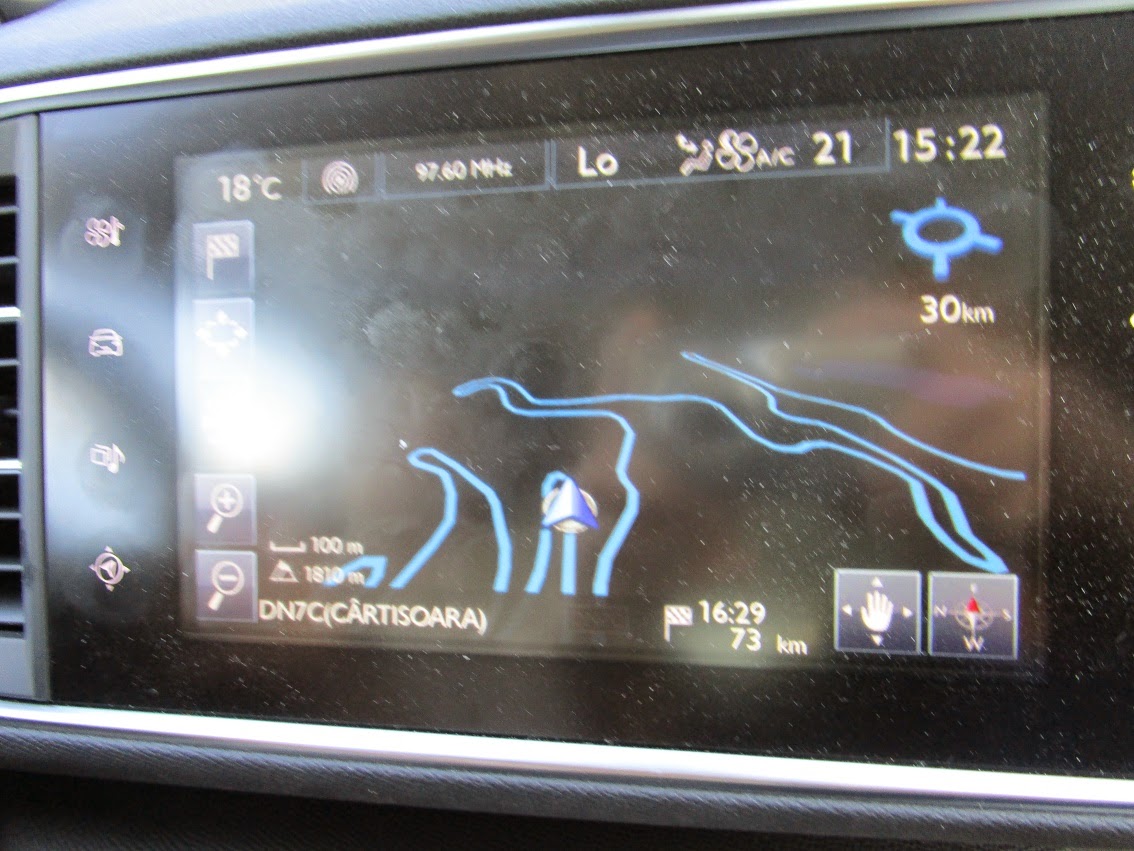
In Australia, we are used to unsealed roads that are mostly pretty good, wide and reasonably smooth where one can travel at 40 or 60 or 100 kph. Here, a secondary road is more like a narrow cobble-stoned Roman road in poor condition – with pot-holes and wheel-ruts scarcely distinguishable from its better sections. A 4WD with high clearance and low range gearing would handle it easily (at 5 kph), but our Peugeot 308 urban sedan had insufficient clearance and was geared too high to allow us to travel at an appropriately low speed, especially when travelling uphill. We are grateful for angelic protection!


We're all shook up oo-ooh


In direct contrast was the Transfaragas highway, made famous as being the “Top Gear” road of the year. Build under the direction of Ceausescu as a military road, it twists and turns back on itself as it climbs over and beyond the mountain ranges. The scenery was spectacular and with the road was in good condition. Anne even managed to take some photographs rather than keeping her eyes shut as we passed the steep drops on the side.(If you want to experience this road 'live' google the Top Gear episode. We drove slower than they did though!
 
 
You don't need to know Romanian to get a sense of what this means!
 
 
Sheep get priority


Testing the spirits
 
In contrast to Spain, and Western Europe in general, eastern European custom is to offer spirits rather than wine with a meal. These spirits are highly effective at soothing frayed nerves (e.g. from driving the risky, rough roads, or after being disoriented while hiking). To further mask the spirits’ efficacy, the locals add flavours, perhaps from stone fruits, berries, or even the leaves of forest trees. Let the buyer beware!


Which is the innocent jug? 


The generous supply of spirits were matched by the ample three course meals we were provided with. After a day’s hiking, and with the cooler mountain temperatures, the soups were especially appreciated.


Pancakes are a popular dessert...or a middle of the day snack to break the drive!


Romania Part 2: Travelling back in time


Perhaps the most striking impression we have is the historic quaintness of people’s lives. Some 45% of the population is engaged in agriculture, and in the mountainous regions where we travelled, much of the labour is expended in semi-subsistence farming.

Agricultural technology

In Australia, if one were to poke around abandoned farm sheds, one would see old leather horse harnesses and obscure carpentry or blacksmithing tools hung on the walls, and rotting and rusty wagons in the farm’s graveyard. I have clear memories of such items from the sheds of my childhood. Here in Romania, those harnesses, tools and wagons are still very much in daily use on the roads and small farms. 

Haymaking

We took countless photos of farmers, and indeed the whole family, going about their work (it’s haymaking time here) using  scythes, wooden hand-rakes, wooden pitch-forks, horse-drawn wagons. Hay is made throughout the summer, with the grass from freshly cut sections of a paddock being turned by hand-rake or pitchfork to encourage drying, then either hung on wooden racks for complete drying, or stacked into a kind of tall igloo-stook, reminiscent of our children’s  ‘Grugg’ storybooks. The most fascinating part of the latter is that when the loose stook has dried enough in the paddock, it is tipped over onto a wagon (horse-drawn of course), and taken holus-bolus to the hayshed – where it is transferred by pitchfork to the ‘hayloft’. Animals will be housed under the loft during the winter. We stared in disbelief that so many acres at a time are harvested in this way, often by the extended family busily working all day. Late in the afternoons was best, with many wagons loaded with hay on their way back to the village houses – yes – most animals are kept within the village confines.


Cutting hay by hand


Usually we would see families working together, but sometimes it was just a single old man or woman working alone in a large field


Drying racks, where the hay is hung out to dry like washed clothes


The small hay stacks were everywhere. Village houses may have just one or two in the yard.


Finally the end product is loaded onto a wagon for storage in sheds.


Small hay sheds like this dot the country side in some areas


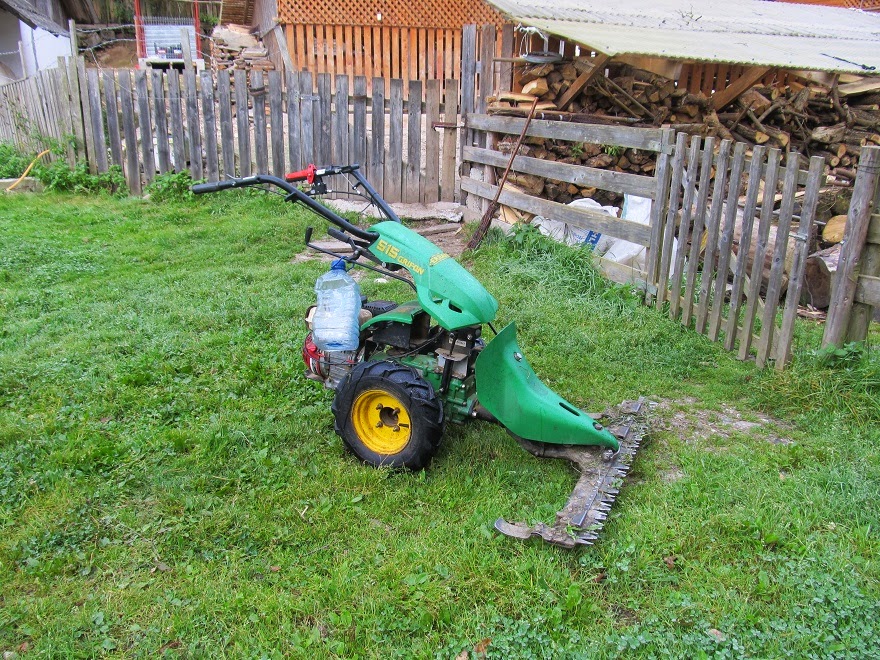
Engine driven ‘rotary hoe’ style mowers are becoming common, being taken to the hay paddock on a horse-drawn wagon!


Animals

There are few fences, and cows and sheep are usually accompanied and tended by the farmer – a vivid illustration of the good shepherd imagery of Biblical times! Many of the animals wear bells that announce their whereabouts. A large sheepdog is used to keep them from wandering and to protect them from wolf, bear, lynx and the Aussie tourist.

Winters are terribly cold and the villages are often snow-bound. During the summer, sheep and cattle are kept on the high country. It seems that their milk is used to feed to pigs, or is made into cheese.

It is very easy to build a romantic picture of life the way it used to be and is, but the reality is that this is a subsistence level of agriculture and life. 


Cows and horses often graze on the side of the roads and seem to have good "traffic sense". Even the pig took care!

Taking the family cow out to graze

A shepherd tending a large herd of sheep.  Usually we saw just a few animals being watched over 

Shepherds dogs (on top of the hill) barking a warning not to come closer. Our advice was to always wait for the shepherd to come and not to try to advance or run from the dogs - they are well trained in their task of keeping the sheep safe
 
It also needs to be said that in the wide valleys and plains  broad-scale agriculture is practised, with expansive areas of maize, sunflowers and haymaking obviously cultivated with modern technology.


The other side of Romania: good roads, extensive agriculture and large towns.  But even the main highways may have to be shared between horses and semi-trailers.


Romania Part 1: Overview


Romania is a land of contrasts: mountains and plains, large cities and tiny villages, modern, large-scale agriculture and industrialisation alongside horses and wagons.  Wooden village houses, medieval old towns, grey communist era housing blocks, Orthodox churches stand alongside Roman Catholic cathedrals and even the occasional Lutheran church. No mosques. In the next pages we share our experiences (and just some of our 1,000 photos) under various sections.

 
In each of the countries in which we travel, we quickly realize that in order to understand what we see, we need to understand some of its history. A Google crash course in Romanian history helped us.
 

Early Roman rule extended to Romania (those Romans were everywhere!) followed by waves of occupation by other races or nations, including Bulgaria. Over the centuries, parts of current Romania were under the Turkish Ottoman rule, while others were under the Hungarian Empire, at whose encouragement Saxons (from Germany) also settled.

 
Romania’s borders as we know them now are a result of treaties made after WW1. After WW2 Romania became a communist state, for much of the time lead by Nicolae Ceausescu.  Although he seemed respected by outside nations, Ceausescu's spending put Romania on the brink of bankruptcy and to counteract this Romanians experienced severe shortages in food, fuel and other essentials. Now seen as a dictatorial megalomaniac who built his monuments on the blood of the people, he was overthrown in 1989 (and executed) and the country is now a democratic republic and a member of the EU and NATO. 


The lavish parliament building built under Ceausescu (above) with the adjoining buildings to the left and right (below) . We toured the parliament and gained a glimpse why it is said that it is "built on the blood of the people"


The title for this museum says a lot. At the same time, people can cite positive things from a communist regime, e.g. no unemployment.  
 
With this historic background, we could better understand why it was that there are regions having differing architecture, where Hungarian and German where spoken, and where the 'monuments' of Ceausescu's reign impose themselves on the landscape.  Romania is still one of the poorer countries of the EU and this is evident in much of the infrastructure, as well as its low cost structure.  It is another country where we can live very cheaply, but where the minimum wage is equivalent to 200 Euro ($300 Australian dollars) a month, so costs are still high for the local people. 


Where is Romania?
 
Map of Romania
Romania and its neighbouring countries: Bulgaria, Serbia, Hungary, Ukraine and Moldova
  
 
Romania is about the size of the state of Victoria, and has a population of some 20 million people. Bucharest, the capital, is a large, modern city with wide roads and grand buildings. There are many large towns throughout the country, with populations of several hundred thousand and busy  industrial areas.  

About 2% of the population is Gypsy (Romani). Eighty six percent of the population is Romanian Orthodox, while Lutherans are in a grab-bag of Protestants comprising a total of 5%.

The Carpathian Mountains dominate the central/northern parts where we spent most of our time.
 
We entered Romania from the Bulgarian city of Ruse, driving first into Bucharest in the south, and then north to Cluj-Napoca in the Transylvania region. From there, we drove in a large arc (1,000 km) through the regions of Maramures, Carpathian Mountains and Transylvania, returning to Cluj after two weeks. We next plan to drive to Budapest, the capital of Hungary.

It is fair to say that we had been somewhat tentative about travelling in Romania. However, we have been delighted with what we have experienced. The majority of our travels were done in conjunction with Green Mountain tours, a company that has regional and rural tourism at its heart.  We undertook a 15 day self-guided driving and hiking tour which took us to some of the less frequented tourist places.  Accommodation was prearranged for us and the hikes helped walk off the very generous meals we enjoyed. We had unlimited internet in all places, and were often amused to see the driver of horse and wagon talking on his mobile phone. Everywhere we went we found only friendliness and helpfulness, with people expressing surprise that we had come from so far away.

Guest houses typical of those where we stayed