Wednesday, 20 August 2014

Snapshots from Bulgaria


We stayed in Bulgaria for twelve days, and for ten of these we were hosted by members of Servas (a hospitality organisation). This experience gave us an insiders' look at the nation and its rich history.  Without wishing to trivialise the complexity of its history, key periods and events were:

The Neolithic period (several thousand years BC). We visited a museum where the remains of a very early Neolithic village were displayed, but no photos were allowed.
 
 
A rich Thracian culture developed in the fertile valleys and numerous remains are still being found. The Thracians were a group of Indo-European tribes inhabiting a large area in Central and Southeastern Europe around the fifth century BC.
 

At a Thracian temple. .


Settlement by the Romans (200 BC to 500 AD)
 
 
Excavation of Roman sites are still being carried out. Here a backhoe is removing soil around the perimeter of the ruins. (Carefully, we hope)


In the town of Plovdiv, Roman ruins are used as a venue for concerts and performances


Occupation by the Turks for 500 years, finally being liberated with the support of Russia in 1878. Many towns have impressive monuments dedicated to those who fought in the various wars. We were very impressed with the historical knowledge of all whom we met.


An oath taken by freedom fighters in the 1870's


Bulgaria was on the losing side in both World Wars,  and was then under Communist government until 1989. One of our guides described Bulgaria as still being in a state of transition after communism. Much evidence of these years is evident in the shabby-looking infrastructure of the country. We were also surprised to see people still employed at laborious manual tasks,e.g. using a person to sell tickets on the trams (a ticketing machine?), or to water public lawns with a hand held hose (a sprinkler?).
 
There are many dull, grey and unattractive housing blocks in the cities, a legacy of the communist years.  We stayed with a family who lived in these sorts of apartments. The interior was most comfortable.

 
We saw more broad-scale agriculture here than in the other countries we crossed. Under communism, prior small-scale holdings had been amalgamated. After communism, the land was offered back to the original owners, but by then many had moved away.  The large areas are now operated by companies.

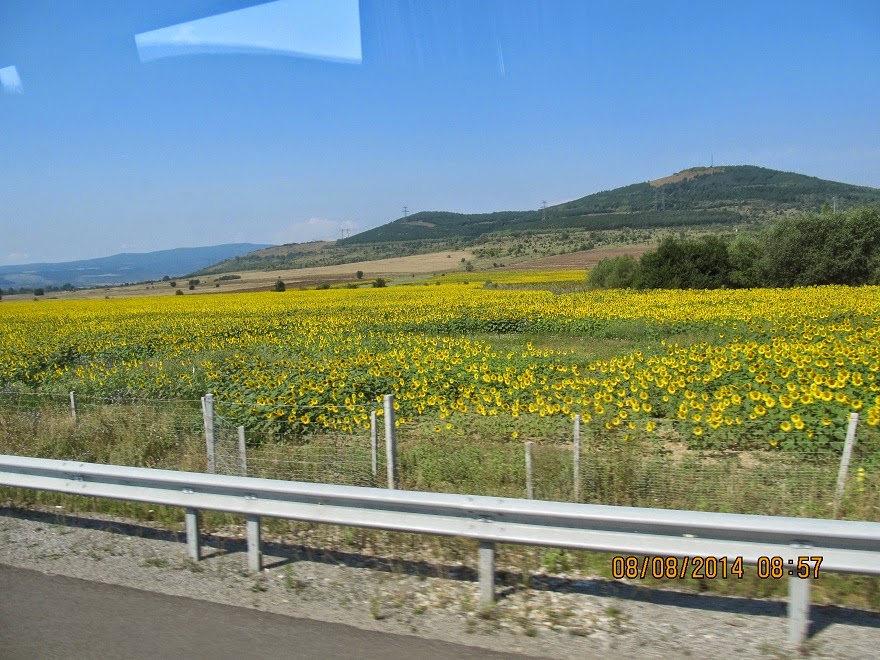
As we moved further south in Bulgaria large areas of sunflowers were drying off......unfortunately we missed the best of their golden faces
 

This was the first dry pastures we had seen in Europe since arriving in March.

 
Bulgaria is now part of NATO and EU, but is one of the poorer countries. External funding is coming into the country and many infrastructure projects (particularly road-works) carry signs indicating EU support. Incidentally, Bulgaria can still provide twelve months maternity leave at existing salary, and a second twelve months at the minimum wage.


The main religion is Eastern Orthodox, although there is also a small percentage of Muslims and Protestant Christians.

The Orthodox churches have their unique architecture and style of worship. One of the most famous churches (at Shipka, pictured) is dedicated to the Russian, Ukrainian and Bulgarian soldiers who died for the liberation of Bulgaria in the Russian - Turkish war.


Rituals and symbolism that is impressive, but which we don't understand


Inside a typical Eastern Orthodox church
 
Orthodox cathedral in the capital, Sofia


There are a number of historic monasteries.  One at Rila was founded in the 10th century and is one of Bulgaria's most important cultural, historical and architectural monuments.


An Orthodox priest who was willing to pose for a photo
 
Detailed paintings adorn all of the walls and ceilings


We were fascinated by rock monasteries carved into cliffs. Dating back to the 14th century, these kept the orthodox religion alive during the Turkish occupation.
 
 
After climbing 132 stairs, one enters a small cave decorated with paintings from the 14th century, still bright and clearly discernable


Candles lit in memory of loved ones
 
 
Along a country road
 
Through the generosity of one of our hosts we stayed four nights in the small village of Koprivstitsa where they have a weekend house. Koprivstitsa is a  village in Bulgaria noted  for its traditional architecture and the many museum houses within it.

The house where we stayed

Note the wood stacked up, ready for winter. We were pleased we were here in summer!

Village scenes. Notice the rough cobbled street and the hobbled, tethered horse 
 

Honey for sale......along with jams and many other tourist attractive items


Being at Koprivstitsa was like stepping back in time. Many of the local people still use horses and carts on a daily basis for their transport and farm work. Some small hayfields were being cut with scythes with the hay then loaded onto the wagons for stacking. The wrinkled faces of the older men and women with walking sticks and headscarves hint of a life beyond our experience.
 
We really enjoyed seeing men with their horses going to work each day. One morning Bob saw them loading a single furrow iron plough into the wagon 
Through a village doorway


Hay may be cut with scythes and gathered by hand-rake Of course, it is not all done like this and Bulgaria had much broad scale agriculture as well


Country roads were narrow and often in poor condition with potholes, and with vegetation growing right up to and encroaching over the roadside.  However, in many ways we felt safer there than on the busier roads, where we seemed to be the only ones obeying the road rules.
 
Drive carefully on these roads, with potholes (above) and vegetation right to the edge of the roadside (below)  


And remember to watch out for horses and carts (above) and tight corners (below)


An image from our GPS, showing the road ahead
When driving on the back roads one sees many villages that are falling into neglect, along with rural land that seems to be overgrown or abandoned. This is typical of the drift to urban centres that is happening in many countries.
 
Overgrown villages and abandoned buildings


A visit to a working museum took us back even further in time. Here we were particularly interested in the technology made available through the use of water.
 
 
Water wheels provided power for milling, sawing, washing, binding.

Wooden baby walkers from centuries ago (left) and a wooden single furrow plough (right)

A sled for use at weddings (and by someone at Christmas-time)

 
Traditional dress with elaborate embroidery
 
 
Food and drink
 
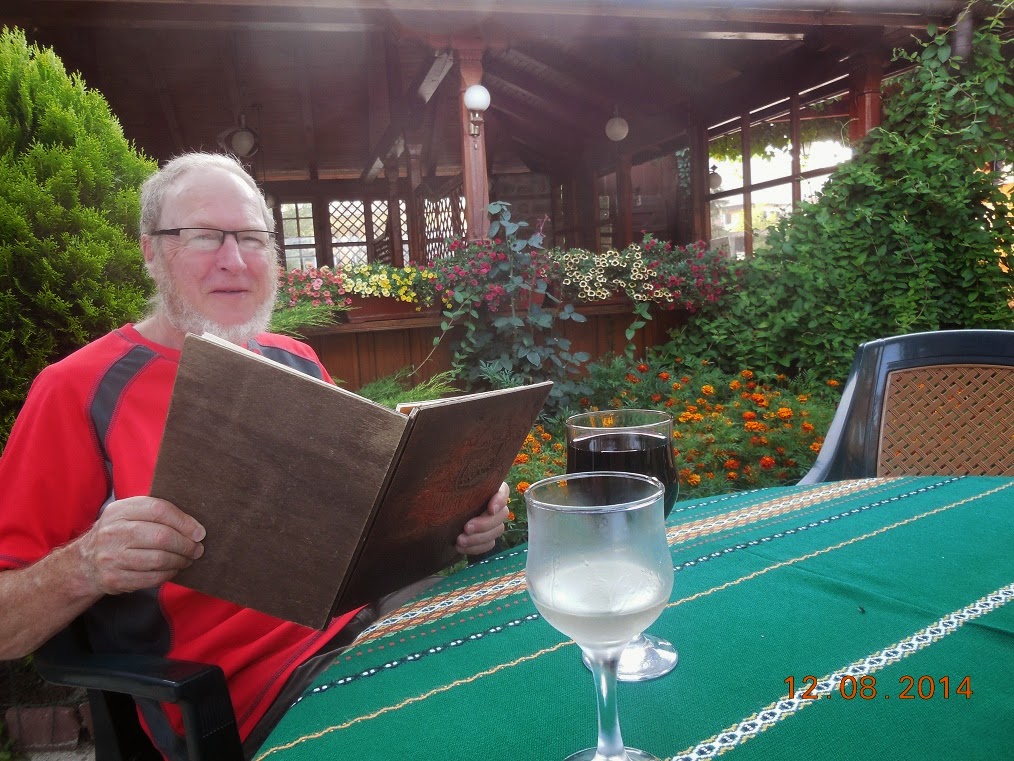
The food in Bulgaria is among the best we have experienced, with abundant fresh salads and a variety of meat and pastry dishes.  An interesting aspect of restaurant menus is that, besides having the name and brief description of each item, portion size is also listed (its weight in grams). Even vendors on the streets sell scoops of their ice-cream by the cone's weight.  Homemade fruit brandies are also common (it is traditional to have a small brandy with salad which is always served as a separate dish at the start of a meal), and the local wines are smooth and very drinkable.


Pigs liver with onions, and cheese on top. Delicious

We wanted a few pieces of cheese to nibble with our drinks but didn't take note of its generous serving size. It was a lot of cheese!


Enjoying a meal at a traditional Bulgarian restaurant with our hosts, Tania and John


Sincere thanks to all of our hosts for opening their homes to us and giving us a rich experience of their wonderful country. We take many fond memories with us.  

And some final, miscellaneous photographs. We now head to Romania where we will spend the next three weeks, two of which will be spend on a self guided driving/hiking tour  We will update the blog after that.  


Market scenes


On the road


Lady begging for money and selling fly swats. There is much less begging here than in other countries we have been in


Chess in the parklands (above and below)


Even if you don't recognize the face, you may recognise the shirt! (Photo taken on a free walking tour. We really enjoy these tours as they are led by young people who are passionate about their country and its history)


Tuesday, 12 August 2014

Four days - four countries

We ended our stay in Croatia by spending a few days in the beautiful city of Dubrovnik. We had been advised by our hosts that it will be full of tourists, but still not to be missed. They were right on both counts. Dubrovnik is one of the classic cities of the world; red roofs on white buildings nestled into the green hillside and hugging the blue Mediterranean.   Dubrovnik came to the worlds attention during the Croatian War of Independence in the nineties, when it suffered bombing and siege. Reconstruction since then allows one to walk around the walls of the old town.

Views of the Old Town from on top of the wall


Dubrovnik hugs the coastline, providing for very scenic walking and driving


The next stage of our drive through to Bulgaria was done with a high degree of caution and some apprehension.  When telling people of our plans, comments ranged from from Oh youre brave to danger, look out for stones, potholes and donkeys, expect to pay bribes if stopped by the police, to the roads are generally good and youll fine.  Well, they were fine and we encountered no difficulty in the drive - apart from the GPS not always recognising addresses, and once taking us on one very long and scenic route.


On Sunday 3rd we left  Dubrovnik (Croatia), and entered Bosnia Herzegovina. The border is not far from Dubrovnik, and following advice from our hosts, we stopped to visit the town of Mostar, an area of Bosnia in which there is a high Muslim population. This is a result of 500 years of Turkish occupation ending in the late 1800's. Mostar is also known for its famous bridge, with the original design built in the 1500's but destroyed in the war of the nineties and since then rebuilt according to the original design.


Mostar bridge (in the distance)


We had no idea of what to expect in the landscape and after driving through quite marginal country (mountainous, hill, rocky) to Mostar, were astounded by dramatic mountain scenery as we neared Sarajevo (gorgeous rugged gorges). Arriving in heavy summer rain, we were very relieved that our GPS was eventually able to locate a hotel in which to spend the night.
 
 
Early scenery in Bosnia Herzegovina (above and below)


Moving into dramatic landscapes as we neared Sarajevo


The city of Sarajevo made a strong impression on us.  Muslim minarets stand along-side of cathedrals. The Old Town has tourist shops with a mix of Turkish and Western wares but it is the rebuilding that is still happening in the city after the war of the nineties that really struck us. Roads are under construction, while large blocks of buildings are still desolate after bombing and many walls bear evidence of fighting, with bullet holes clearly visible. Sarajevo endured the longest siege in modern history, a period of 1,425 days. We took time to visit a photographic exhibition which was deeply moving. There is also a modern side to the city with western style shopping malls and fine hotels. (All of the photos below were taken near our very comfortable hotel)

 
Buildings damaged from gunfire.
 
 Here the restored city hall stands next to buildings not yet restored.

Riverside houses such as these are usually painted and highly attractive, but when a city needs rebuilding some things have to wait
 
 
A mosque at Sarajevo
 

The next day our drive took us across mountain ranges and through fertile valleys where there were small villages and agricultural fields.  We then entered Serbia, initially passing through small towns but as we neared our destination for the night, also passed through very fertile agricultural areas.


Hay stacks
 
 
A horse and cart with a load of loose hay. In the country roads of Bulgaria we see many horse-drawn carts.


We had arranged a two night stay on the edge of a national park, a mountainous area and one of Serbia's top winter ski resorts. In summer however the weather was wonderful and gave us the opportunity to take a days walk in the mountains, a pleasant change from the hours of driving we had been doing.


The very up-market ski resort

  Bob went on a bear hunt


Scenes from our mountain walk


Many people were on the hillsides picking wild blueberries. The wild variety is much smaller than the cultivated ones we know in Australia, but equally tasty.  To pick large quantities people use a special implement (a kind of comb) to take many berries off the bushes at once.

The flowers were beautiful and Anne has many photos of flowers.  We have seen spring flowers in Spain, summer flowers in Eastern Europe and in a few months will catch the autumn leaves.


On the fourth day, we finally entered Bulgaria, where we are staying for 12 days.  We began in the capital. Sofia, where we were hosted by a couple from the Servas organisation and we are now staying in a small village of Koprivshtitsa at a weekend home they own. Using this as a base we are exploring the nearby countryside before moving onto more Servas hosts in other parts of the country (Servas is a hospitality organisation).


These four days of travel challenged us in many ways.

I think we must have read too many spy novels or war stories, for we always held our breath when passing through each border control post. We first of all present passports when leaving one country, then drive several hundred metres until reaching the border control for the next country where the process is repeated.  We also needed to show papers for the registration and vehicle insurance before entering a new country.   This process makes one realise just how much paperwork has been reduced in countries who are full members of the European Union, for there you simply drive from one country to the next.


Out of one country


And into another


Each of the countries we entered also has its own currency, which we needed even for the short time we were travelling through. By the time we arrived in Bulgaria our old brains were struggling to remember what the currency is current, and how it might relate to Euros (and in due course, Australian dollars). At that point it's easier to just pay the amount rather than try to calculate its equivalent.


While we find costs in these Eastern European countries extremely cheap the flip side is that the local people have low incomes. We were told that we would be travelling through 'poor' countries and this is evident in a number of ways: roads that are patched rather than resurfaced, rusty dented guard rails, empty houses or rundown villages, older cars on the roads, lack of major industries. Of course there are variations to this across each country, with some region obviously more prosperous than others.


Older cars, patched roads and  older guard rails (at least there were some!)


Small scale industry in Serbia (or was it Bosnia? - tobacco) and a larger city (below). A major highway goes from Zagreb in Croatia to the south of Serbia, but we only drove on this for sixty kilometres and the rest of the time on minor roads


Apart from each country having its own language, a Cyrillic alphabet is also used. This makes reading signs impossible and we are thankful that our GPS can direct us in English.   Most of the museums that we have been in have at least some of the information in English.
(For the teachers who may be reading this, it makes one realize just how important pictures and context are when learning to read!)


Take your pick and hope for the best


Signs English are limited (but welcome when we see them)


This sign made us realize that we are very far from home!
These four countries are a history buffs delight. The scope of history really stretches our minds but being here - and with the assistance of Google - helps us get an understanding of the forces of history that have shaped these areas. No sooner had we read up on Austro-Hungarian rule, the former country of Yugoslavia and its break up, which preceded the war of the nineties, when we moved into Bulgaria and have now learned about the Turkish Ottoman Empire which ruled here for 500 years, the rebellion of the late 1800's that overthrew it (with Russian involvement), and Bulgaria's more recent move from communism to a democratic republic. 


There are also differences in religion across the countries. In the same four days weve seen Roman Catholic cathedrals, Mosques, and Eastern Orthodox churches. Bulgaria's predominant religion is Eastern Orthodox, and hence the churches are designed quite differently with open spaces, no seating and icons (paintings, sculptures, frescos) covering the walls. (We have not been able to take photos inside)


Each day continues to bring its own surprises, but at the end of every day we are very thankful the blessings received, particularly for safety as we travel through these fascinating foreign lands.