Sunday, 29 June 2014

Medinas, souks and country markets

Medinas, markets and souks

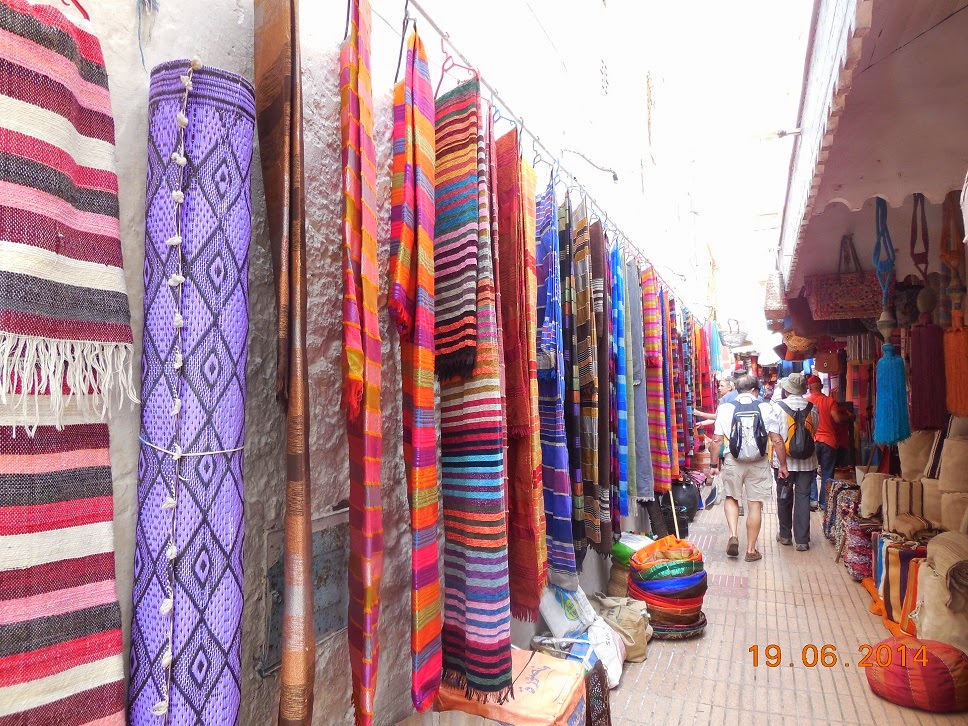
Morocco is famous for its Medinas, the maze of streets which form the old part of a city. Within the Medinas there are various market areas or 'souks' each specialising in making and selling a variety of goods. A Medina is a tourists delight .....but can also be a trap. 

 
Entering a Medina is like entering a living museum that involves all of your senses. There is so much to see: displays of fruit, vegetables, nuts, spices, eggs, breads, pastries all piled high. A little further and you find scarves, shoes, rugs, pottery, metalwork, leatherwork, wooden wares. Beggars sit or walk among the crowds with their hands outstretched, while bikes, handcarts and laden donkeys weave their way among the crowds and at your feet the many cats slink by, searching their areas for food.
 

Smells invade your nostrils, especially the wafting odours of the fish market, but also smells of meat cooking, bread making, mint, leather craft, dyeing all mingling with that of rubbish not disposed of.

Overall are the sounds of selling and buying, begging and bartering; the cackle of hens, the rattle of the loom the beating of metal and hammering of timber. The call of 'Balaak, Balaak' means that you quickly step aside to make way for a laden donkey, carrying burdens as it's ancestors have since time immemorial. The calls to prayer override all of the noise but in the Medina nothing stops.

 
This part is the tourists delight.  The tourist trap comes as the stall-owners try to entice you into their stall. It goes like this...


Shop-owner, warmly: ‘Bonjour Monsieur‘. (A lot of French is spoken here)

Me: warmly sociable – I want tourists to have a good reputation: ‘Bonjour’

‘Where are you from?’

Me, pleased that he’s interested to know about me ‘Australia’

Which city?

Me, even more pleased. ‘Brisbane’

Oh Brisbane. My cousin has been to Brisbane. Beautiful city.

You like Morocco? Yes!

‘Come and see my shop – just see – not to buy anything – just look’ – indicating his eyes

I don’t want to buy anything

Of course not. Not buy, just see Moroccan products.

Me, a little grudgingly: OK, what’s in your shop?

See, I have scarves. You like scarves? Which one you like? I sell for a very good price to you. You are my first customer for the day. Your purchase will indicate a lucky day for me, so I give you a very special price’

Me: No thanks, I don’t want a scarf

You don’t like a scarf? Maybe a carpet. Handmade, very good quality. Made by Berber women.

Me, more grudgingly: I cannot carry a carpet – it will weigh too much for my flight

Perhaps you like a small tagine (a pottery item)? No?

As I move towards the door: You have children?

Me: Yes

You can buy something for them from Morocco. Here, I have some spices and some henna. No, perhaps you like a traditional Moroccan garment. Do you like it?

 Me – trying to humour him. Yes, it’s really nice

Look – only 200 Dirham. Special price for you. No?

I move further. ‘Alright. Two hundred too much? Tell me how much you want to pay – just tell me a price’.

Eventually, in order both to humour him and to permit a dignified withdrawal I say ‘Twenty Dirham!’

Oh no! You can’t be serious. It takes three women one month to make this gown, and you offer only twenty? Look, you can have it for eighty.

This continues, and I’m pleased that I nominated only twenty Dirham, after all I don’t want the item anyway!

As I finally step away, he then says: Alright, Twenty five Dirham! You can have it for twenty five Dirham! Please, twenty five Dirham!

Me: exasperated and aghast at the process shake my head and make my escape!

Not really sadder, but rather wiser about the ways of the Moroccan world!


He tried hard to sell it, but I wasn't co-operating


Watch where your going......and keep wallets and cameras secure


Carpets and tagines in abundance


 Imagine setting up this display each day


The dates and dried fruits are tasty ......so are the fish when they are kept on ice


Pastries often have bees swarming around them, attracted by the sweetness


Baalak, Baalak  (donkey laden with skins from the tannery)
Its crowded around here


And for some light entertainment, try snake charming!!


Souks (specialist craft markets)

As part of the tour we visited a number of factories or co-operatives of various crafts. This gave us an insight into the hard work that goes into quality products, but also got a little tedious with the unspoken expectation that we would always buy something.

Leather
Morocco is renowned for its leather which is made into bags, shoes, jackets etc. This traditional process is centuries old, with the leather being dyed by hand in pits coloured with traditional, natural dyes. Its a very smelly, messy but picturesque process - for the rooftop observer ...


We were given sprigs of mint to hold over our nose to counteract the smell


A good day to dye


A small selection of the leather goods available ....and yes, after bargaining for it, I bought a small money purse


 Ceramics
 The city of Fez is famous for its ceramic work.
The work is painstaking, particularly the way intricate mosaics are formed by hand, with the pattern evolving on the underside.  We purchased a tagine and several small bowls which now need to travel safely in our baggage for another six months
 
 
The potter's wheel
Hand-painting a bowl
 
Chipping and fitting mosaics, piece by piece
 
 
Metalwork
Morocco has its own supplies of silver and other semi precious metals which are turned into jewellery, teapots, plates etc etc.
  
 
These finely detailed  doors stand in front of the Kings Palace at Fez


Silversmith at work: we were told that this is the man who crafted the above doors.


Weaving and embroidery


Rugs, blankets, materials are woven on the loom and we certainly saw some beautiful carpets.....luckily they're too heavy to carry. .
 

Oh no, not more carpets!


Amazing embroidery by Berber women in a co-operative. There are no knots showing, the back is the same as the front and they make up the pattern as they go!


Natural remedies
 
It got up Anne's nose

Shoulder and neck massage with yew-beaut oils


Hand grinding the nuts for Argan oil
 

Country markets

Weekly markets are held in the many rural towns. These are noisy, smelly, bustling affairs, geared to the local people and not tourists, but make for equally interesting wandering.  Hay and grain are bought and sold, donkeys shoed, fruit and vegies laid out on the ground for sale. Being melon season there are trailer loads of water melons, and rock melons and canteloupes in abundance.  Home wares and clothing such as those sold in the 'cheap Chinese' stores fill the aisles, as do second hand goods, tools, bicycle parts etc etc etc.  Since people attend these from rural areas further afield they are also a great social occasions.


Get to the market however you can:  donkey, ute, truck or bike


Grain-trading (above and below)


Grain-trading (legumes)


Freight-forwarding


Sickles, hoes, donkey shoes and more


The onion section


How to load a truck with hay (back view)


How to load a truck with hay (front view)


These are the only sorts of scales we've seen used in the markets or Medinas


They may be on the ground, but the fruit and veg looked fresher than you buy in a supermarket
The melon section


Herbs, particularly mint and coriander, are sold everywhere


Don't forget to buy bark from walnut trees for chewing to clean your teeth......or to use as lipstick (if you like yellow lipstick)


Saturday, 7 June 2014

Our Month in Morocco - first impressions


Gibraltar receding as we leave Spain for Morocco
On Friday 30th May we left the far southern corner of Spain by ferry from a city called Algeciras, to cross the Straits of Gibraltar. The trip took only an hour and a half, and then we were in Morocco. We landed at a port some 50 km from the city of Tangier. It was with a mix of apprehension and excitement that we stepped off the ferry, for the night before we had re-read the warnings about bartering, begging and being ripped off by unwanted guides etc.


Anne setting foot on Moroccan soil

As Arabic and French are the main languages, with English being a very poor third, we were thankful to have the company of  two young travellers (a Canadian, and an Italian who speaks French) and who were the only other Europeans on the boat. These two had met up while walking the Camino de Santiago, and both wanted to see Morocco. With their help we changed our Euro money into Moroccan Dirhams at the port train station and then all took a bus into Tangier city, despite rival offers from local taxi drivers waiting at the bus stop.
 
On the trip from the port to Tangier city, the scenery was rather harsh – already dry, as summer approaches, and almost treeless. We saw wheat being harvested in a number of small wheat fields – by sickle or scythe – then tied into sheaves for later threshing. The same technology used in Australia about 100 years ago! Also, donkeys pulling a cart, or with a saddle-pack.
Our arrival at Tangier city
The Italian guy had explicitly told the bus driver that we needed to get to the train station at Tangier, and checked that he would be able to drop us off there. Agreed. However, when we arrived at the outskirts of city, the driver pulled over at the road-side and insisted that it was the time and place for we four to leave the bus – referring us to a small train station a hundred metres back. We hastily complied - it was a frenetic highway where he stopped - and we were left stranded on the busy, dusty roadside. We were terrified at the prospect of crossing the road, but managed to get to the station via an underpass. There, we inspected the train timetable – it was in Arabic!


Arabic train signage
 
Our Italian friend (Andre) ascertained that if we were to wait there for three hours, the next train would arrive to take us to the main Central Station. Or, we could take a taxi – one was parked outside. The taxi driver was not actually there, but a by-stander offered to drive us in his private car. Andre negotiated the fare, and soon we arrived at the real Tangier Central Train Station. As we arrived, Anne noticed that our Ibis Hotel was quite close, so we bid our friends goodbye, and walked to the hotel, gratefully. Yet another address adventure - we are becoming very wary of bus drivers!

 
The view from our hotel window at Tangier
  
Booking into a "Western" hotel was a good move for us, as it enabled us to slowly absorb a different culture, which we did by taking small forays at first and gradually extending these to wider areas. We began with walks along the beach front – a long wide sandy stretch frequented by numerous men and children playing ball games, with many of the women gowned and scarfed and their infants watching from the edge. All very calm and civilised and a family scene which could be found on a beachfront anywhere in the world. This is unlike the traffic, and the pedestrians who step between moving cars at intersections. There's not much choice really – either because there are no traffic lights, or because lights and crossings are complied with only optionally. The traffic is crazy, with  few apparent road rules and much beeping of horns. When we need to cross a road, we stand close to other pedestrians at the roadside, and follow them closely when they step into the traffic. With practice, we are ourselves becoming emboldened, pleased that drivers don’t blast us with their horns or strike us down.

Beach-side scenes at Tangier

A beach chick
 
We next ventured into the edges of the city’s medina – an ancient maze-like urban trading zone full of people trading the full range of consumables – fish, fruit, vegetables, kitchen wares, electrical items, clothing, horse heads (for eating) – or were they donkey’s heads (?).  An unrefrigerated fish market was not the most pleasant place to walk into. We also discovered the 'Take Away Chicken' street, where the hens are kept in small pens and at request are slaughtered, feathered, and gutted before your eyes, ready to cook. The narrow ‘streets’ are congested with shoppers, but not so congested as to deter pushers of hand-carts or drivers of scooters, cars, and the ubiquitous motor cycle/ute hybrid vehicle. 


These bikes are everywhere and carry a variety of things on the back. This is a newish one but most look as if they have seen better days.


Anne managed to negotiate purchase of an orange, a small but significant achievement, all the while unsure through our unfamiliarity with the notes and coins, if she was being ripped off with pricing. That uncertainty persists, first thinking we are charged far too much (14 Dirhams for two ice-creams – man!) – and then thinking ‘man what a bargain! Under two dollars for two ice-creams!’
A quiet section of a medina street. We would love to take more photos of the many and varied sights in these market places,   but one needs to ask permission first and at times it has been refused.


Scenes at the fish market at a medina.  Very smelly!


The huge fish on the floor is being cut into pieces


Scene at a 'takeaway chicken' shop in the medina


After 2 days we travelled by train from Tangier to Rabat, a 4 hour journey. The train was full and hot, until someone got the air-con working half way through the trip. We shared a cabin with four others, who spoke a little English. Toilet was of the good old-fashioned type – straight onto the tracks.


Our train from Tangier to Rabat
 
 
We passed through mostly flat country with many miles of wheat, irrigated fruit and vegetables, gum-tree forestry (!), and cork-tree forestry. In the rural areas, donkeys and horses are used as commonly as tractors and cars, along with motor cycles with their various ute-tray configurations.


Our cabin companions alerted us when we arrived at the main Rabat train station. We  commenced to follow the carefully-written directional instructions supplied by the lady we are staying with. While the route was only 1.4 km, involved only one turn to the left, and the instructions were detailed, we again managed to make the exercise quite complicated, taking three times the required time! Out-of-date street signage, un-named streets and signage only in Arabic contributed to the experience, as did wrong and contradictory directions offered by locals – all without a common language.


Here in Rabat we have stayed in a spacious apartment with a young American lady as our host and have had a very restful and relaxing time.  We’ve become quite confident as we roamed many parts of town, crossed many streets, been misplaced repeatedly , yet always gotten home safely. We have walked through the maze like streets of the Rabat Medina and found the areas where quality goods are made and sold - carpets, leatherwork, fabric, shoes, embroidery, carvings etc. Having to carry anything we buy in our rucksacks curtails one's wish to buy!
Without either Arabic or French, we’ve also procured more restaurant meals, a haircut, the services of a tailor to adjust my trousers, and more ice-creams. With delight, we have found the food to be varied and delicious. Restaurant eating is very cheap and we are becoming more confident in trying some of the 'street food'. No tummy troubles yet!  We've also become used to the calls to prayer emanating over loud speakers from the many mosques.

The order and menu at a Syrian restaurant, with the menu written in French and Arabic.  We wondered why the menu started with coffee and dessert until we realized that in Arabic, books start at the back.
The end result of our order.


The tailor who altered Bob's pants. It was  tiny with barely room for us both, but he wanted Anne in the photo as well. Using only sign language he understood what we wanted and did a perfect job.

A man taking his shoes off before entering the mosque.  Most people seem to ignore the calls to prayer. Once we saw a group of men at prayer in the Medina, all kneeling on a large prayer mat.
Having lived in Papua New Guinea and Bob's visit to China some years back have helped us adapt to a county that has been described as 'being on the edge of both a third world and a western culture'. A very accurate description.

 
Urban and city areas both reflect a country with overall low levels of personal income and infrastructure under construction, but whose progress is slow or stalled. Examples would be: well-made bitumen roads, but no footpaths or traffic lights; vast amounts of empty plastic bags and drink bottles accumulating in the weeds along the roadsides; countless residential apartment buildings under construction, again seemingly not being completed; many buildings are inhabited, but the finishing touches such as external plaster or facades and landscaping are absent – just rough concrete walls, weeds and rubbish. At the same time there are obviously many wealthy Moroccan and there are well developed and attractive parts of the cities. Besides, by peering into open doors in the streets, we see that the exteriors of drab buildings can belie sophisticated and elegant interiors. 

roadside rubbish viewed from the train


In the middle of Tangier city


A developed area of Rabat. Out of sight are new bridges and a new tramway.
 
We are aware that these are only first impressions and that this first week has been spent in the most 'cosmopolitan' part of Morocco.  Here we have been surprised at the western dress of many Moroccans, especially the younger women. It has been quite common to see couples, young and old, holding hands as they walk along (and even more behind the rocks at the beach!). This is despite the books telling us that this is culturally inappropriate for us to be seen doing. We may find that many of these practices are different in more remote areas.
 
Anne has become confident to walk the streets by herself, but careful to dress appropriately with long pants and long sleeves. A very common sight here is men lined up on chairs outside of cafes drinking mint tea or coffee and watching the world (or women?) go by. We both feel uncomfortable at this.

A row of men seated outside a cafe. Islam forbids alcohol
 However, there is a 'sly grog shop' over the road from where we are staying which receives its steady, shady business.

Tomorrow we travel to Casablanca and on Sunday will meet up with our tour group. This will be first time we have gone on such an organised tour, so we'll see how we go. The tour lasts for two weeks and our next blog post is most likely to be done only after the tour.