Tuesday, 8 April 2014

Milestones and mud


Our experiences since the last blog post have been quite amazing …

The adventures started with our train ride from Huesca to Jaca. We had decided to do this in order to avoid being mid-way through an isolated, poorly serviced section of a national park track during a period of forecast rain several days hence. This was a really good idea, and we loved the luxury of wonderful views without expending any energy! The journey took us firstly through the same sort of agricultural areas that we’d walked through for two weeks. Then a climb up through a gorge in the foothills of the Pyrenees – a gorge we’d seen from afar in preceding days.

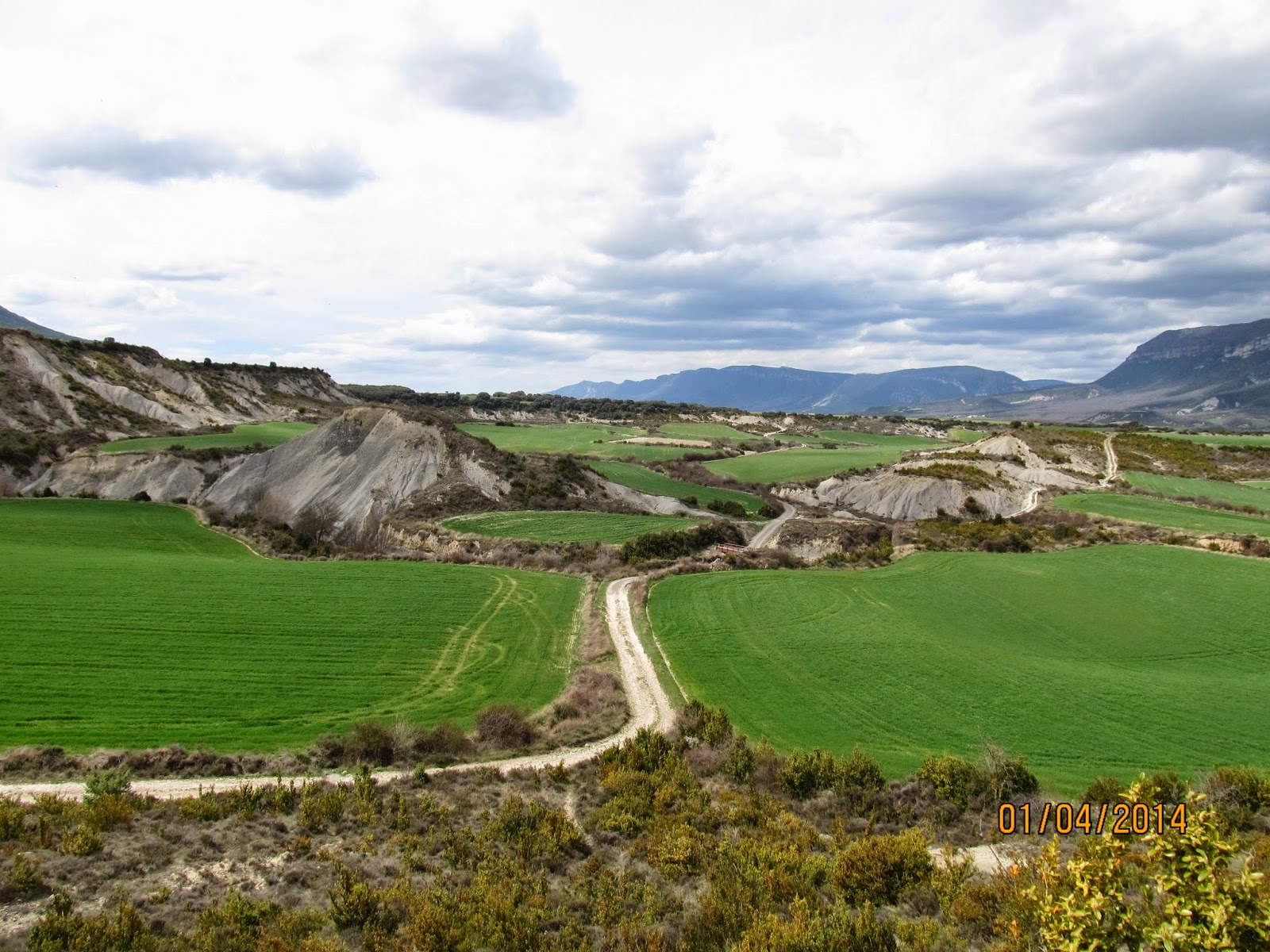
We see this sort of scenery every day on our walk and have stopped taking pics


After two hours of train extravagance, we arrived at Jaca, a town that is a few days’ walk in from France on yet another Camino route (the Aragones way). We arrived at noon, and made our way through the town and onwards to our night’s accommodation some 15 km away. This all worked out really well – high country agricultural vistas, complete with shepherd tending his sheep, some of which had bells, whose constant melodic ringing evoked memories of children’s stories from Switzerland.

The next few days merge into one.

Adventure 1:
This day put our fitness to the test. After a night’s rest at a town called Artieda, we first walked about ten km to Ruesta, an ancient village, now largely a ghost town. That was OK. We dawdled there over lunch, expecting ahead more of the same sort of paths, gradients etc we’d grown used to. Instead, after descending about 50 metres, we started regaining that altitude. That’s the easy part. We climbed that 50 metres, then 100 metres, 200 metres, on and up, ever onwards, ever upwards, eagerly seeking a glimpse around each bend in the winding road, so we could congratulate ourselves on winning the battle against muscular fatigue. But each new curve brought yet another distant crest into view, dread to our minds, and played havoc with our determination to win. Well, I think we lost. No, I think we won. After seven km and four gruelling hours (about 2:00 pm) we finally did in fact reach the crest of the mountain range and ‘collapsed’. We gratefully ate our 'bocodillos' , and slowly, slowly regained our determination, and in fact satisfaction, that we are indeed strong, successful adventurers yes?
 

The next day was equally adventurous – what an innocuous word. This time we were treated to a four hour slog up a hellish mud path – not just wet, dirty mud – but sticky clogging mud that stuck to our boots (maybe 500 gm per boot), coated our trouser legs with mud, built up as a thick second-level sole under our boots, making our foothold slippery when we managed to find a more stable base, threatened to up-end us or dislocate our backs if we were to slip. All the while, rain was threatening, a chill wind was blowing, we had no idea for how much longer this upwards torture would continue, and not another soul in sight to save us if something were to go wrong.


Having given up on reaching the crest of this interminable climb, we paused at 2:00 pm for lunch in a deserted cattle shed. Its smell was reminiscent of our childhood farms, so this revived our spirits a little - maybe.
 
A solitary Austrian hiker travelling in the opposite direction informed us that our next town was still six or seven km distant – cold comfort.

Incidentally, on our slog through the mud, we were following two other sets of footprints. These turned out to be those  Frenchmen – aged just ten years older than us – and when we met up with them that night, of course they too were exhausted and had in fact slipped and fallen a couple of time. So we were grateful for our physical (and mental) strength and fitness, that only a little light rain fell and for our safety while slogging through that long, arduous and lonely quagmire.

Post script. We did survive to the summit of that climb. We arrived cold and weak at a village ten km short of our destination, where a phone call in my very best Spanish resulted in a taxi arriving half an hour later to take us to a hostel in Monreal. Hot showers, whiskey, soup, salad, red wine, roast meat and dessert worked their magic and we slept like babies.
 

Next morning was a fresh new day, sunny and bright, and fortunately we had revived. Not sure of the km distance to our next town (probably about 20 km), arriving in good time. Bob went to the local bar to enjoy his daily ration of whiskey, when an hour of Australiana appeared on the bar’s TV screen. The content included thirty minutes shot in SE Queensland, followed by a round of tourist attractions from all the states. It was a bit of nostalgia for the pilgrim who’d been away from his homeland for so long (four weeks …).
We have seen this sort of scenery every day and have stopped taking pics


Blissful rural scenes
 

Since then there have been no new adventures. Just continuing wonderful scenery, and congenial company among the numerous fellow-pilgrims who are trekking along the French Way section of the Camino. It has in fact been a small adventure to encounter the pilgrim throng that we are now part of. I shall explain. During the first three weeks of our journey, we travelled alone (with each other of course). Of the 23 nights, we shared the hostel accommodation with others on only three occasions, and basically met no others at all on the pilgrim path. Then abruptly, on day 24, after 350 km, our Catalan and Arogones Pilgrim Way converged with the more popular French Way at Puenta la Reina. What a change! Immediately there were dozens and dozens of men and women of all ages (twenties to eighties) clamouring to find a bed at a huge hostel of some 120 beds before it was all filled up. Aren’t we lucky that the Camino season starts only in June!


It was awful having to share the dorm with 15 women
 

Our most recent two days have been less eventful. Better paths, no chance of getting lost (lots of Camino arrows, emblems and fellow travellers. It’s been so good that we decided to have rest day (just ten km today). We are at a comfortable hostel where we are catching up on photo management, journal writing, and this blog.


 The way the Camino ought to for the whole 1,000 km


 A typical bar - café/bar/meeting place for the townsfolk, especially the men, who often play cards while drinking tiny cups of coffee. Or maybe spirituous liquor, at breakfast time ...


The main street (Calle Mayor) of Puente la Reina


 A typical bridge

 An exposed portion of a ridgy-didge Roman road


The same road


An ancient olive tree

Monday, 31 March 2014

Two weeks into our weary pilgrimage


The title belies our experience! Alright, we are a bit weary, but it’s marvellous what a day’s rest, and a glass or three of red can do!

We now are at a small city called Huesca in central eastern Spain, having walked 240 km in the past 16 days. We’ve loved strolling through the quiet rural countryside, with fields of barley and of rye lying on either side of the river … experienced strong chilly headwinds, and enjoyed the warm hospitality shown by the townsfolk wherever we’ve been. Parts of our hike evoke images of Jesus travelling with his disciples through similar fields (OK, in another country, but the mental images seem to be the same …). At other times, we sense the long history – Roman times, and the evidence of many subsequent conflicts and conquests of which modern-day Spain (along with Europe in general and even Australia) is a result. Hopefully we enrich this text with a few photos. We marvel every day at the richness of our generalised Western heritage embodied in both the ruins and modernisation in rural and urban situations alike. For example, large-scale farming and modern city buildings sit alongside of evidence of subsistence farming and ‘tribal’ warfare of previous eras, while medieval city walls are incorporated with 20th century city planning. Everywhere, we continue to be surprised that pretty much everyone lives in multi-story apartment buildings within city/village confines.

We are also constantly amazed, and more often confused, by eating customs – times and what people eat – so we regard every food order at a café as part of our journey. Today for instance, on a bleak wintry day, when we envisaged hot soup for lunch, we were served two cold mussels …? OK, followed by small platters of other menu items. But it’s just not like the food of home!

We’ve walked through and stayed at towns that provide wonderful views of the surrounding countryside. Expansive, vast views of agricultural crops, almonds and native trees, with the snow-capped Pyrenees as a backdrop. Worth every drop of sweat (except it’s been so chilly cold …).

As an aside to my (Bob’s) academic colleagues, you may be surprised to learn that I haven’t given a thought to Bayesian Networks etc. Whatever thoughts of UQ that cross my largely vacant mind are those of ‘pity’ for those who still serve out their sentences, unaware that freedom is achievable in their own lifetime … Perhaps I owe you a profoundly philosophical ‘meaning of life’ presentation when I return safely …

BTW: We’ve decided to modify slightly our Camino route. Tomorrow, we will take a $10.00 train ticket from Huesca to Jaca, cutting out 75 km of walking in exchange for certainty of accommodation and removing the risk of rain when walking through long stretches where there are no food supplies - that could greatly interfere with our plans and safety.


Sunday 30th March. We appreciated a warm night’s sleep in the comfort of a hostel – a three-star hotel room ($50.00 a night). Among other things, we found the railway station, where in halting Spanish to a disinterested attendant who professed no knowledge of English, I said that we would like to go to Jaca tomorrow by train, and would like one-way tickets. He duly wrote down the times of travel, the cost, and processed our ticket purchase. A considerable achievement!

Also today, we happened to walk into a cathedral just as a worship service was beginning. In stark contrast to our local Brisbane place of worship, this cathedral was huge, ornate, full of golden statues and artistic depictions of Biblical events. We could vaguely relate the liturgy to our traditional Lutheran way of doing things. Impressed by female reader, and the priest’s singing to the accompaniment of his guitar. Also the ‘passing of the peace’ – a truly universal church, for all its failings of one kind or another.

Light rain set in on the cold day, and we longed for plates of warm soup and the Sunday roast. Mmmm. What we found at one of the many bars/restaurants/cafes was OK, but in no way matched our Australian dreams.

More thoughts?

We so appreciate the small expressions of warmth shown to us strangers. For instance, yesterday, when we arrived in Huesca, we were delighted to accept the hospitality of an elderly gentleman (he may have been my age …), who offered us a ride in his car from the free pilgrim’s hostel, to a commercial hostel where we would have free wifi and other comforts.

Where both parties want to communicate, even few common words suffice.

Chance encounters greatly enrich our experience – friendly ‘angels’ who show us where to find food and shelter, unexpected vistas – some undeniably magnificent in their own right – others trivial – like Hairy MacLairy and his band of town dogs who we met at Pueyo de Fananas (Hairy MacLairy is a NZ children’s book series – for those without small children in their lives). Soon after arriving at Huesca our ears were assaulted by a deep, semi-rhythmic drumming. Eventually, we ventured onto the streets to find out what on earth it could be. In fact, it was a parade of some forty bands from surrounding regions, all in traditional regalia, pounding and beating drums in an organised procession down the main street. All a prelude to the real event of Holy Week, just three weeks off. What a fascinating sight and sound!
 
Photos to follow when we have good wifi access and time
 
Looks like the stars have aligned ...


Carpenter, electrician, whatever ...
 
 
Where did I come from mama?


Sunday, 23 March 2014

Rest days


We have now walked 115 kilometres, thus were very happy to have arrived at the town of Balaguer where we had pre-arranged accommodation last year, via one of the hospitality websites. In the time we have been walking we have stayed twice in private rooms, twice in albergues (or community hostels), a convent and a ‘hostal’ (a cheap hotel). Each of these has its own unique characteristics, but it is especially good to be in a home again. We realize how a home has a warmth that reflects the lifestyle and values of those who live in it. Our current host, Jordi, is inspiring in his commitment to a self-sufficient lifestyle. We have enjoyed his soup, salads, breads made with his home grown and home ground wheat and dried fruits and nuts.

Our last three days of walking took us through mainly flat agricultural areas, which kept Bob’s mind challenged as he observed the different agricultural practices.  There were many acres of fruit trees and young crops, all looking very healthy and maintained with extensive irrigation channels. Not an animal was to be seen, yet the presence of pigs was very obvious from the smell which followed us much of the time. Jordi tells us that there are more pigs in Catalonia than people, and we are ready to believe it. Like most of Europe, animals here are kept in sheds and do not graze freely in open paddocks.  

We have been here at Balaguer for two and half days and have spent the time resting and eating lots and can feel our bodies being the better for it. Tomorrow we will set off again and walk for 17 kilometres to the next town. When possible, we like to limit our daily walking distance to 15 – 20 kilometres: however, the spacing of accommodation on this particular section of the Camino does not always allow for this.


Wednesday, 19 March 2014

On the road

As we missed posting photos from previous entries, here are some from when we were still tourists.
 
 
Ruins at L'Escala.
Remains of a harbour dating back to the Phonecians


Ruins of a Roman town


Entry through the archway. The large stone on the ground at the front had clear indentations from chariot wheels.


Now in Barcelona
Our hotel was opposite large food markets which provided a visual and sensory feast. While Bob was sick in bed I enjoyed wondering through the stalls.
Mmmmmmm Chocolate anyone.  (for the sake of children who may be viewing this, I have omitted the photos of sheeps heads, pigs heads and various other organs!


The Sagrada Familia cathedral is one of the most beautiful buildings in the world. Photos really cant do justice to the sense of space, peace and intricate design. The cathedral is due to be finished in 2030.
 
Pillars resembling tree trunks rise to the ceiling
 
 Simple stained glass windows (as well as some clear windows) fill the building with light
 
The outside is covered with a multitude of carvings of Biblical figures and figures from nature

 
Monserrat, the point of departure for our walk.


 As mentioned briefly in the previous post, we commenced our walk from Montserrat, a cathedral/monastery and world heritage region perhaps 50 km from Barcelona. This is a most imposing place, with a monastery situated high in the mountains. The monastery is famous for a number of things, including the Black Madonna, a statue of Mary and Jesus in which the faces are black.


There is also a school for boys, specializing in music, and the boys sing at a service each day – except the day that we were there!  Anne attended an evening service at which the monks sang, and we both attended a morning service before we left. Of course, we couldn't understand a word of it, but that didn't matter.


The landscape around the monastery is unique for the pillar like rock formations which tower above it. Being there after the tourists left gave Anne the opportunity to see the changes as daylight turned to dusk and then to night. 


In spite of Bob being unwell, we took those all-important first steps and started our walk.


We had decided that we would only walk 11 kilometres (we think it was a long 11 kilometres!). Walking conditions were pleasant – mildly sunny but with a cool breeze, and our path took us on a combination of tracks and roadside walking. The scenery was magnificent, although spoiled somewhat by a lingering haze. The track was quite well signed and in any case, we have printed and digital notes to help us.
 
 
We are now in a private room in a “Casa Rural” – a house/restaurant that rents out rooms to pilgrims. Tonight we have a room to ourselves. Still adjusting to Spanish meal times, Anne is waiting hungrily until 8 pm when a pilgrim menu will be offered. Bob is already in bed as his sickness means he is not eating much.

 
Our next challenge is to see what things we can take out of rucksacks to make them lighter!!

Day 4

We cannot always access wifi, so postings are dependent upon that, as well as the energy we have left at the end of the day.

Bob is vastly improved in health and we have been lengthening the hours we walk. Yesterday we overdid it in order to reach the accommodation we wanted, and so had a shorter day today, with some time for rest. Overall though, we think we are getting fitter and stronger.
 
Up until midday yesterday we had done a lot of walking on the side of busy roads – noisy and not particularly scenic. Since then we have been on quieter tracks, walking through rural countryside which is green with the early growth of spring crops, and splashed with the pink of trees in blossom. Having missed the significant change of seasons since living in Queensland, it is very pleasant to enjoy this season.


To this point we have been blessed with very pleasant weather, as well as roads which are not unduly arduous in height.   We are learning about the amounts of  food and drink we need to keep us balanced. Many villages have water fountains to top up our supply.


 We follow yellow arrows which are painted on rocks, trees, street poles or buildings.
And look, we're nearly there. Only 960 kilometres to go!!!


In a few days we will reach the home of one of our contacts from a hospitality site. Our next posting will likely be from there.


Saturday, 15 March 2014

First steps


The past days have seen a balance between quieter and busier times.  A highlight while still in Girona was a visit to LEscala, where we 'time travelled' back to the Phoenicians landing at this site, with walls of their harbour still visible.  Greeks and Romans also settled here and we spent time wandering the ruins of these ancient villages.  

We left Girona feeling very thankful for the hospitality of Quim and Carolina; thank you again to these wonderful people.


Travel to Barcelona was by way of a high speed train. We were not fully prepared for the size of this city (population 1.6 million) and all that there is to see. This was complicated by Bob being unwell, so a hop on hop off bus was the best way to gain a feel of what we could see if there was another time.  The absolute highlight was a visit to the Sagrada Familia cathedral, designed by Gaudi and still under construction today. What a masterpiece this is, and even amidst the tourist throng, a sense that the spirit of God is very present.


A quick update on Sat morning 15th March from Montserrat, the start of our Camino (pilgrimage). Bob is still feeling quite unwell severe cold in the head and chest so well walk only 11 km today. Yesterday (Friday) we caught trains from central Barcelona to Montserrat the serrated mountains, where a huge, elegant cathedral has been built high among the rocky peaks. We slept in an albergue (pilgrim hostel). A dozen others also overnighted here and have already headed off.


We are holding off the inevitable having to walk the first metres of an arduous 1,000 km trek over the next three months. We attended a (catholic) Mass this morning at the ornate Basilica. Didnt understand a word, but conscious of Gods presence and our need for His strength.

Tuesday, 11 March 2014

Simply Spain


With rucksacks packed, passports checked and re-checked, and farewell hugs to family, the time of our departure from Brisbane finally arrived. After an eight hour flight to  Singapore, followed by a wait of four hours for our connecting flight, then another fourteen hour flight it was a relief to hear the words  "Welcome to Barcelona.  We hope you have had a pleasant journey and enjoy your stay".


We looked at each other with nervous anticipation and so began our long planned for adventure. Negotiating airport and trains to our first hosts at Girona, an hour and a half north of Barcelona, proved to be quite simple, especially with the help of several friendly people.

At Girona, we were met by Quim and Carolina, people we had been in contact with for a long time via the internet, so it was a pleasure to meet them at last. Their warmth and friendliness made it a perfect place to readjust our bodies to a different time zone and to absorb the culture and landscape of Spain. We have not found it difficult to get over jet lag and have been able to quite quickly absorb all that is new.
 
The first section of this white building is 'our' house at Girona.
 
First impressions of Spain include the high density of population, with the majority of people in towns and cities living in apartments; a landscape that is just experiencing the first taste of spring, with most trees still bare but the first signs of leaf and blossom evident; the mix of old and new with the 'old town' or medieval villages right alongside the shops and services of today. Girona (and Barcelona too) is within an area known as Catalonia, a province with its own language and customs. The people of Catalonia are currently pressing the Spanish government for their independence as a nation and a common sight is the Catalonian flag hanging from walls and balconies.
 

On Sunday, Quim and Carolina took us to a town called Torroella, where we walked up to the top of a stony mountain to view the remains of a 13th century castle at Montgri. Actually, the castle was never completed because of changed political circumstances and the inhospitable environment. Evidence of past times is never far away in this part of the world.


After the walk we went to a nearby rural restaurant with friends of theirs, and a meal of seafood paella most tasty and made us appreciate ancient regional cuisine in the modern world.  

We also visited two medieval villages complete with narrow, unpredictable streets and always an ancient church at the very top of the hill. All inevitably built 100% of stone. These villages are strikingly similar to those wed previously seen in the south of France and in Italy. It would be a fascinating experience to stay a few days in one, renting rooms and eating out ... its nice to dream.


 Eating out is very common here, with the whole society is geared for it not as something you do just as a treat when no-one wants to do the cooking, but as a frequent part of family and social life. Were very impressed!

So far, weve had mild sunny days and cool nights to help our tourist travels be very enjoyable. Well need more once we start our Camino our adventurous and arduous walk from town to town 1,200 km across Spain, That all starts on Saturday 15th, so until then were actively appreciating the life of indolent tourists.